Orthodontic Appliances: The Precision Tools Behind Your Smile
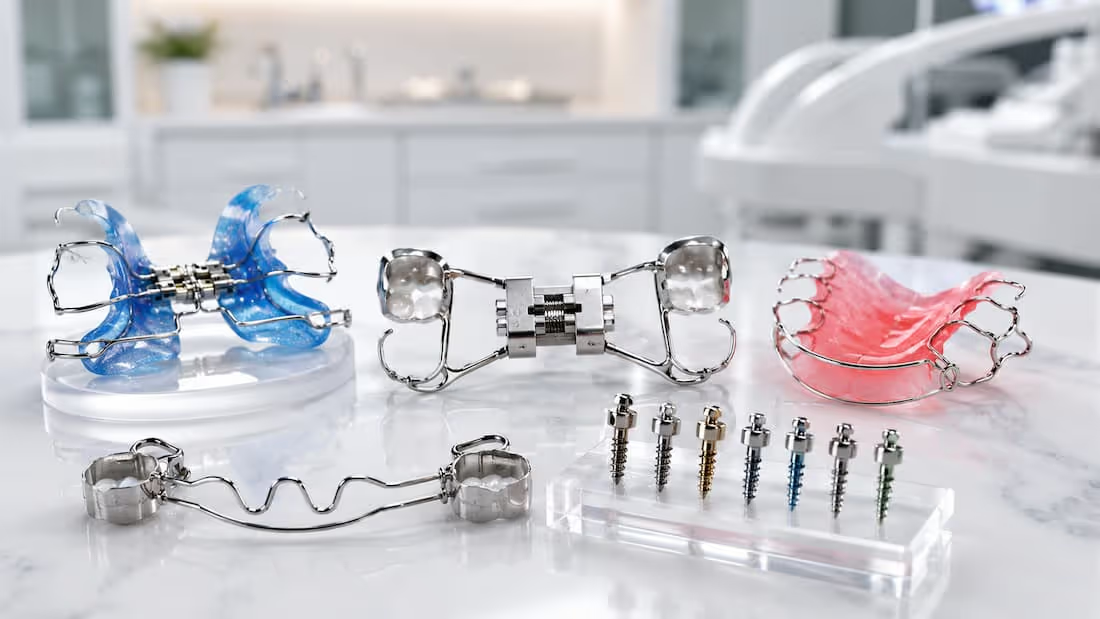
Dr. Tahir and Dr. Lia don't use appliances because they're available. They use them because a specific case needs a specific tool. Here's every appliance we work with and what it does.
Expansion and Growth Appliances
Palatal Expanders
Gradually widens the upper jaw by putting gentle pressure on the growth line that runs down the middle of the palate. Creates space for crowded teeth, can improve breathing, and sets up a better foundation for permanent teeth.
Patients turn a small key once a day to activate it. Active expansion takes a few weeks, then the expander stays in for several months while new bone fills in. Most effective in growing kids whose palate hasn't fused yet, but modified versions can work for teens and some adults.
This is one of the most common appliances we use and one of the most impactful. A few weeks of turning can prevent years of more complex treatment.
Carriere Distalizer
Moves upper molars backward to correct the bite without pulling teeth. Works before or alongside braces and can cut overall treatment time by fixing the bite relationship early.
If the back teeth are in the wrong position, everything in front of them is affected. The Carriere fixes the foundation so braces can do their job faster.
Bite Correction Appliances
MARA (Mandibular Anterior Repositioning Appliance)
A fixed appliance that guides the lower jaw forward to correct overbites in growing patients. Works continuously without depending on the patient wearing anything. Fixed in place so compliance isn't a factor.
One of Dr. Tahir's preferred tools for adolescent bite correction, especially for teens with Class II bites where the lower jaw sits too far back.
Forsus Springs
Fixed springs that connect to your braces and apply constant forward force on the lower jaw. Work 24/7 without the patient needing to do anything. Attached to existing braces so there's no separate appliance to manage.
Patients adjust to Forsus springs within a few days. They look more intimidating than they feel.
Herbst Appliance
A telescoping device that holds the lower jaw in a forward position. This is one of the most powerful bite correction tools available. Produces significant results in growing patients with major overbites. Fixed in place so it works around the clock.
The Herbst is the heavy hitter. Dr. Tahir and Dr. Lia use it when the case calls for maximum correction in the shortest time.
CS5
A newer precision appliance for mild to moderate bite correction. Less invasive than a Herbst or Forsus but more targeted than elastics alone. Good option when the bite issue is real but doesn't need the most aggressive tool in the kit.
Rubber Bands (Elastics)
Small bands that connect upper and lower braces to guide bite correction. The most common appliance in orthodontics and essential for correcting overbites, underbites, and crossbites. Worn 22+ hours a day, removed for eating and brushing, then replaced with fresh ones.
Full-time wear produces results in weeks. Inconsistent wear stalls progress and extends treatment. Elastics are the one appliance that depends entirely on you. Everything else on this page works whether you think about it or not. Elastics only work if you wear them.
Click here to read more about rubber bands.
Facemask (Reverse-Pull Headgear)
Used for underbite correction in growing kids. The facemask pulls the upper jaw forward while gently limiting lower jaw growth. Most effective in patients under 12 with active growth. Typically worn at night and for several hours during the day.
Early intervention with a facemask can reduce or eliminate the need for jaw surgery later. That's a big deal.
Bite plane
A custom acrylic appliance that corrects deep bites by slightly separating the back teeth so they can come in further and level out the bite. Gentle, effective, and often used alongside braces. Works especially well in growing patients.
Bite planes do a lot of quiet work. Patients barely notice them but the correction they produce is significant.
Space Management Appliances
Space Maintainers
When a baby tooth falls out too early, the teeth on either side start drifting into the empty space. That blocks the permanent tooth from coming in where it should. A space maintainer holds the gap open until the permanent tooth is ready.
It's a simple little device that makes a huge difference. Prevents the kind of crowding and misalignment that leads to longer, more complex treatment later.
Lower Holding Arch
A fixed wire behind the lower front teeth that keeps the arch width stable while baby teeth are falling out and permanent teeth are coming in. Invisible from the front. Prevents teeth from shifting during the transition. Essential for preserving space in kids with a mix of baby and adult teeth.
Nance Appliance
An upper palatal appliance with an acrylic button that rests against the roof of the mouth. It anchors the upper molars in place and prevents them from drifting forward when we're closing space elsewhere.
You won't see it when you smile. But it's doing critical work behind the scenes.
Transpalatal Arch (TPA)
A fixed wire connecting upper molars across the palate. Stabilizes molar position and prevents unwanted rotation or expansion during treatment. Invisible from the front. Works quietly in the background while braces do the visible work.
Anchorage
Temporary Anchorage Devices (TADs)
Small titanium mini-screws placed into the bone to act as fixed anchor points. They let us move specific teeth in directions that braces alone can't achieve. Placement is quick, minimally invasive, and painless with local anesthesia. They're removed once they've done their job with no lasting impact on bone or surrounding tissue.
TADs are especially valuable for severe crowding, moving molars backward without affecting other teeth, avoiding extractions in cases that would otherwise need them, and complex movements that require a fixed anchor point.
Sounds intense. It's not. Patients are usually surprised how quick and easy placement is. TADs are one of those tools that quietly make impossible cases possible. Dr. Tahir's decades of experience and advanced training make him exceptionally skilled in both placing TADs and designing the biomechanics around them.
What Makes Cool Braces Different From Old-Fashioned Orthodontic Solutions



Frequently Asked Questions
A custom device that gradually widens your child's upper jaw. You turn a small key once a day to activate it. It creates space for crowded teeth, can help with breathing, and works best while your kid is still growing and their bones are flexible. The active phase takes a few weeks, then it stays in for several months so the new bone can settle. Sounds intense. It's not.
A little discomfort in the first few days after placement or adjustment. Pressure, tightness, maybe some soreness. Not sharp pain. That's not expected. Most patients adjust within a week. If something feels sharp or off, call us. We'll sort it out.
Depends on the appliance and what it's correcting. Space maintainers stay in until the permanent tooth comes through. Expanders are active for a few months, then stay in several more to stabilize. Bite correctors like Forsus or MARA typically run 12 to 18 months. TADs go in during treatment and come out when the job is done. Dr. Tahir and Dr. Lia will give you a specific timeline for your appliance at your consultation.
We're Ready When You Are.